Be understood the first time.
One on one accent and pronunciation coaching for professionals who already speak fluent English. Keep your accent. Stop repeating yourself. Work with an internationally accredited coach trained in speech & drama, on the sounds that are costing you clarity.
Book a free chemistry session →A relaxed conversation, online or by phone. No pressure, no pitch, just a chance to see if we are a fit.
- Clarity
- Confidence
- Credibility
Your English is excellent. It is the being understood that is exhausting.
You end up saying it twice
“Sorry, say that again?” on every call. You repeat yourself, a little louder and a little slower, and the second time it lands — but the moment has already passed.
Your ideas land lighter than they should
You know the subject better than anyone in the room. Yet somehow it is someone else’s version of your point that gets picked up and credited.
So you start saying less
You keep your contributions short and safe, let the big meetings pass, and the most capable version of you never quite gets into the room.
Here is the part most people never hear. This is not about losing your accent, and it is not a fluency problem. It is a handful of physical sounds your first language never asked you to make — and sounds are a craft. They can be taught, practised, and made your own.

Keep your accent. Gain the clarity.
Actors retrain how they form sounds all the time — it is ordinary, technical craft, taught patiently and practised until it becomes automatic. Fiona brings that same speech & drama training to the sounds that are getting in your way at work.
You will not be asked to sound like a New Zealander, and nothing here treats your accent as a fault to be corrected. The work is precise and physical: which sounds, formed how, and practised in what order. Paired with ICF accredited coaching, it rebuilds something that matters just as much as the technique — the confidence to speak up without bracing for “sorry, what?”.
- 01
Finding what is actually getting in the way
We start by listening to how you really speak — reading aloud, talking about your work, the words you use every day. Fiona identifies the specific sounds and habits costing you clarity. It is almost always a shorter list than people expect: a handful of sounds, a rhythm pattern, and pace.
- 02
Retraining the sounds themselves
This is physical, practical work. Where your tongue sits, what your lips and teeth do, how the sound is actually formed. You will work through targeted drills and tongue twisters built around your first language, because the sounds that are hard for a Portuguese speaker are not the ones that are hard for a Mandarin speaker.
- 03
Putting it into your real working life
Technique only counts when it survives a live meeting. So we take it into your actual work — your terminology, your presentations, the client call on Thursday, your own name said the way you want it said. The goal is that you stop thinking about it, and simply get understood.
What we work on, specifically.
The sounds that trip people up
TH, both voiced and unvoiced (the, then, there versus think, three). V and B. R and L. The ends of words, where sounds get dropped. “-ing”. And long versus short vowels — coast and cost, host and hot.
Where your tongue, lips and teeth go
Every English sound has a physical position. TH, for instance, needs the tongue between the front teeth — a placement that simply does not exist in many languages. Once you can feel where a sound is made, you can make it reliably, instead of hoping it comes out right.
Rhythm, stress and pace
English carries meaning in which words you lean on. Stress the wrong syllable and a familiar word stops being recognisable, however cleanly you pronounce it. We work on emphasis, where to pause, and the speed that actually helps you be understood.
The voice itself
Pitch, tone, projection, emphasis and pause — the modulation that makes someone worth listening to. Clarity gets you understood. This is what makes people want to keep listening, and it is where Fiona’s speech & drama training does its most distinctive work.
Which of these matters most depends entirely on your first language. The sounds a Brazilian Portuguese speaker works on are not the ones a Mandarin or Hindi speaker works on — so the exercises are built around the language you actually speak, not handed out from a folder.
This is for you if…
- English is your second (or third) language, and you are tired of being asked to repeat yourself
- You are senior and technically excellent, and you want your ideas to carry the weight they deserve
- You present to clients, boards or teams in English and want to feel certain you are landing
- You want to keep your accent — you simply want to be understood the first time
- Particular sounds catch you out: TH, V and B, R and L, the ends of words
- You have been told to “slow down”, and it has not fixed anything
The people you recruited for their expertise.
Most organisations have them — engineers, clinicians, analysts, project leads, lecturers and academics brought in from overseas precisely because they are excellent, who are being held back in meetings, lectures and presentations by clarity rather than competence. It shows up as being talked over, being passed over for the client-facing work, and eventually as a resignation you did not see coming.
Universities and tertiary providers especially. Teaching teams are increasingly made up of second-language English speakers who lecture, supervise and present for a living — where being understood the first time is not a nicety, it is the job. Fiona already works with university teams.
Fiona works with these people one on one, online, around a working week — for one person or several. It sits comfortably within a professional development or inclusion budget, and she can invoice your organisation directly. Get in touch and she will talk you through what it involves.
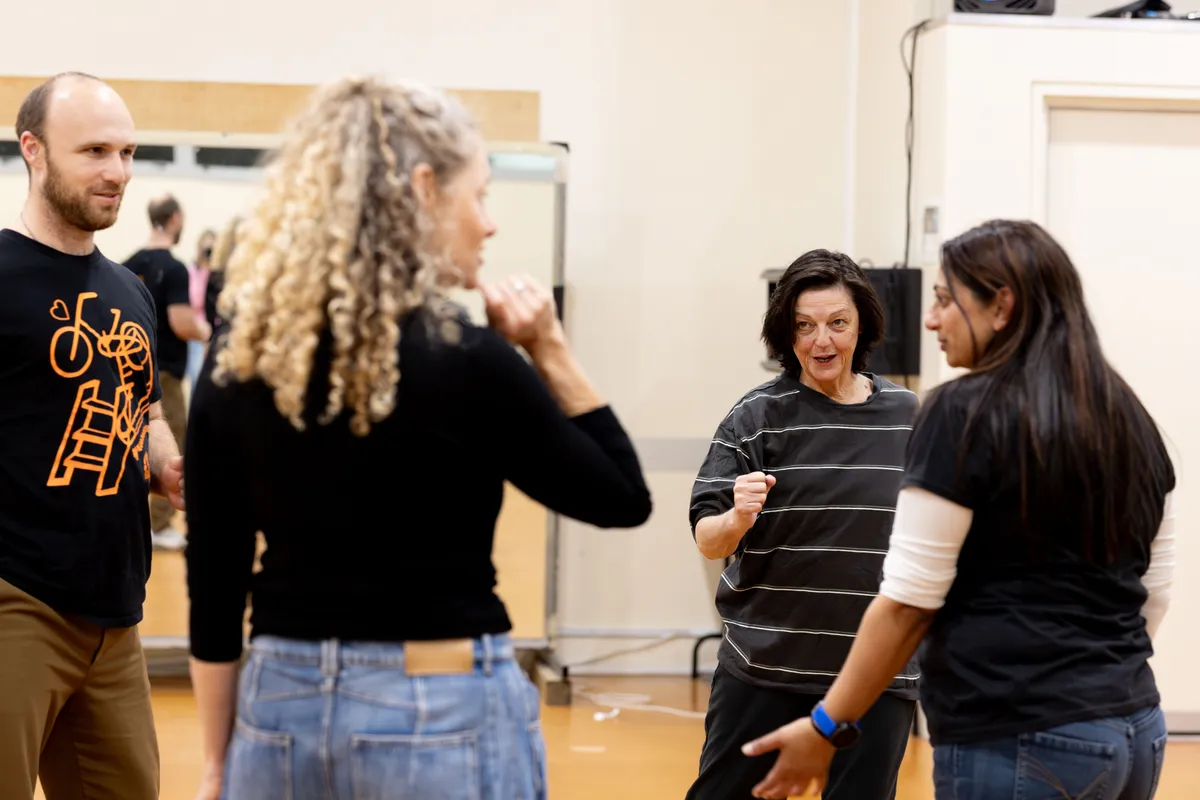
Trained in the mechanics of speech, guided with heart.
Fiona Mogridge is a trained actor, speech and drama teacher, and internationally accredited coach. Speech & drama is the discipline of how sound is physically made — articulation, breath, placement, pace and tone — which makes it the natural home for accent work. She has been teaching people to form English sounds for the better part of her career.
What makes the difference is that she pairs it with coaching. The technical side matters, but so does what sits underneath it: the meeting you stopped speaking up in, the presentation you handed to a colleague. Fiona works on both, so you leave able to say what you mean and be heard the first time — still sounding like yourself.
- ICF Accredited Coach (ACC)
- Trained Actor
- LTCL & ATCL, Speech & Drama
- Human Synergistics LSI & GSI
What is a “chemistry session”?
It is a relaxed, no obligation conversation, online or by phone, about what is getting in your way, what you would like to change, and whether working together makes sense. Fiona will also be honest with you about what is realistic, and how long it is likely to take.
Self conscious about how you speak, even one on one? That is completely normal, and it is exactly the sort of thing we put at ease from the very first hello. You will not be judged here — this is the one room where your accent is simply information to work with.
Common questions
Will I lose my accent?
No — and that is not the goal. Your accent is part of who you are and where you are from, and there is nothing wrong with it. This work is about being understood the first time, every time. Most people finish still sounding unmistakably like themselves, simply clearer. If anything, they sound more confident, because they are no longer bracing to be misheard.
How is this different from English lessons?
Completely different. English lessons teach you the language — grammar, vocabulary, comprehension. You already have those; you are fluent, and probably working at a senior level in English. This is about the physical production of sound: how English sounds are formed in the mouth, and how rhythm and stress carry meaning. It is speech coaching, not language teaching.
Does it work for my first language?
Yes. Which sounds are difficult depends entirely on your first language — Portuguese and Spanish speakers often work on TH, V and B, R and L, and vowels added to the ends of words, while other languages bring an entirely different set. Fiona builds the drills and tongue twisters around the language you actually speak, rather than a generic worksheet.
Can we do this online?
Yes, and most of this work is done online. It suits video especially well, because you can see the mouth position clearly on screen and play sounds back. Fiona works with clients well beyond New Zealand this way. In person sessions are available in Auckland and the surrounding areas.
How long does it take?
This work is one to one, and usually takes at least three to six sessions. That is not a sales package — it is how long it genuinely takes to shift a behaviour and build new muscle memory in the tongue, lips and mouth so a new sound becomes automatic. Sounds you have formed the same way your whole life do not change in an hour. Most people hear a difference in themselves well before the end, and Fiona will give you an honest picture of your own starting point in your first conversation.
Do I need to practise between sessions?
Yes, and it does not take long. A few minutes most days does more than an hour once a week, because you are retraining muscle memory. You will leave each session with specific, targeted exercises — the tongue twisters exist for exactly this reason.
Can my employer pay for it?
Very often they do, and many organisations are glad to. It sits naturally within professional development or an inclusion budget, and Fiona can invoice your organisation directly. If it is easier, she is happy to speak with your manager or HR team about what the work involves.
Is this the same as public speaking coaching?
They overlap, but the starting point differs. Public speaking coaching is about nerves, structure and presence for high stakes talks. This is about being understood clearly in English at all — in meetings, on calls and in everyday work. Many people do both, and Fiona will tell you honestly which one you actually need.
Book your free chemistry session.
Tell Fiona a little about what you would like to work on — the sounds that catch you out, the meetings where it matters, or simply that you are tired of repeating yourself — and she will be in touch to arrange a time.